
Spring Scouting vs Fall Scouting Why March and April Are Your Most Valuable Months
Spring scouting is not the off-season consolation prize — it is biologically and tactically the superior scouting window of the entire year, and this comparison article makes that case with thirty years of wildlife biology behind it. Wildlife biologist and Navy veteran breaks down the structural differences between spring and fall scouting across eight key variables in a side-by-side comparison table, then works through the four primary spring scouting advantages in depth: fully exposed terrain that reveals saddles, funnels, benches, and bedding cover invisible under October canopy; old sign that reflects uninhibited natural behavior rather than pressure-adjusted fall behavior; zero-cost reconnaissance with no pressure consequences; and an honest assessment of what fall scouting is actually legitimate for. Closes with a complete three-phase spring scouting framework covering February through May.
Allen
4/27/202616 min read
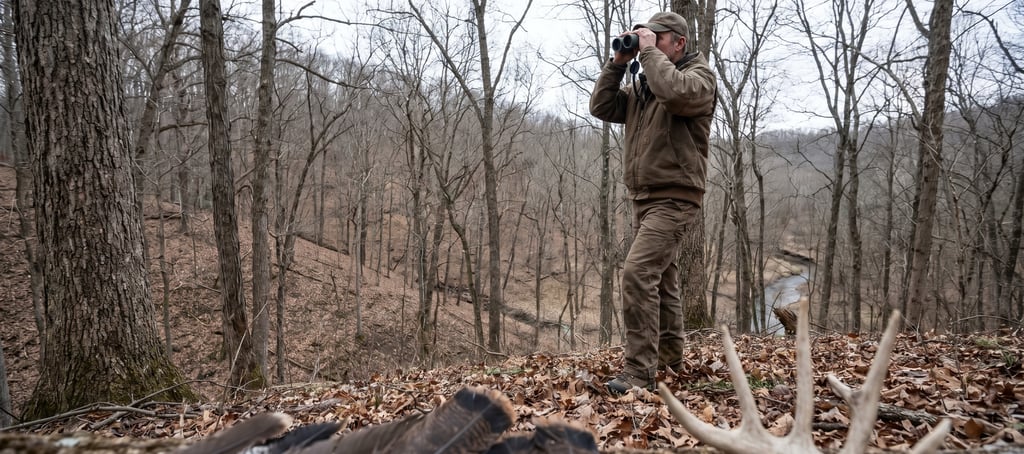
There is a version of whitetail scouting that most hunters practice — and there is a version that actually works. The first version happens in September, when the woods are lush, the bucks are in velvet, and optimism is at its seasonal peak. You walk your property, hang a stand, bump three deer, and call it a scouting trip. The second version happens right now, in March and April, when the woods are bare, the ground is soft, and every terrain feature, funnel, and bedding area on your property is sitting in plain sight waiting to be read.
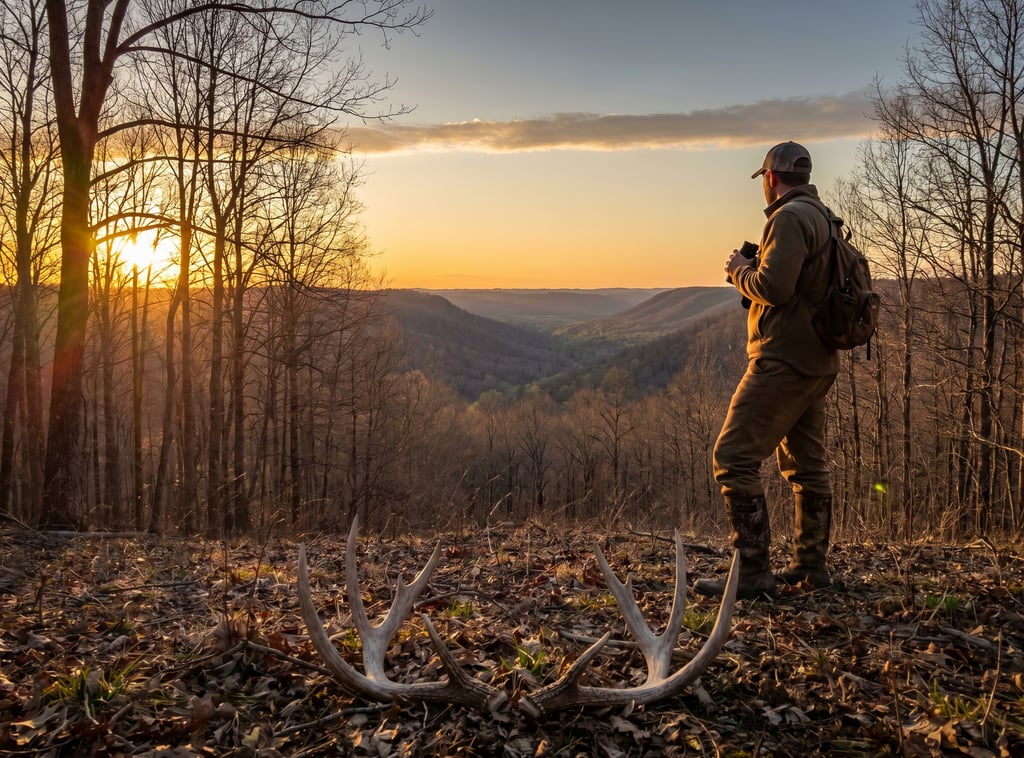
Spring scouting is not a consolation prize for hunters who ran out of things to do after shed season. It is, biologically and tactically, the superior scouting window of the entire year. The foliage is down. The sign is fresh. The pressure is zero. And the terrain tells you things in March that it will spend the next seven months hiding from you behind a wall of leaves.
Think of it as the difference between reading a map with the terrain features clearly marked versus navigating the same ground in a full-on communications blackout with zero visibility and someone actively jamming your signal. Fall scouting is the jam. Spring is the clear channel. Both the Navy and the Marines can appreciate that analogy — though knowing those two, one branch would insist the map was wrong and the other would have already walked past the objective twice without stopping to check.
In this article we will break down exactly what spring scouting reveals that fall scouting cannot, why March and April are the biological sweet spot for this work, and how to build a systematic spring scouting approach that directly improves your whitetail deer hunting strategy for the coming fall. Let's get into it.
Spring vs. Fall Scouting: The Core Comparison
Before we get into the specifics of what spring reveals, it helps to understand the fundamental structural difference between scouting in spring versus scouting in fall. These are not just different seasons — they are different information environments. What you can see, what sign you can find, and what conclusions you can draw are categorically different depending on when you walk your property.
Spring vs Fall
Canopy fully down — terrain fully visible Canopy up — funnels and terrain hidden
Zero hunting pressure on deer Deer are actively pressure-aware
Old sign confirms last season's use patterns
Fresh sign may reflect pressure-altered behavior
Bedding areas easy to locate and assess Bedding areas revealed only by pushing deer
Stand sites can be evaluated without risk Stand evaluations spook deer from hunting areas
Rubs and scrapes confirm last fall's activity
Rubs and scrapes are fresh but context is missing
No time pressure — scout at your pace Every intrusion has a real cost in October
Shed finds confirm survivor buck locations
No shed data available — survivorship is unknown
These comparisons tell most of the story at a glance, but the details behind each comparison are where the real hunting intelligence lives. Let's work through the most important advantages of the spring scouting window one by one.
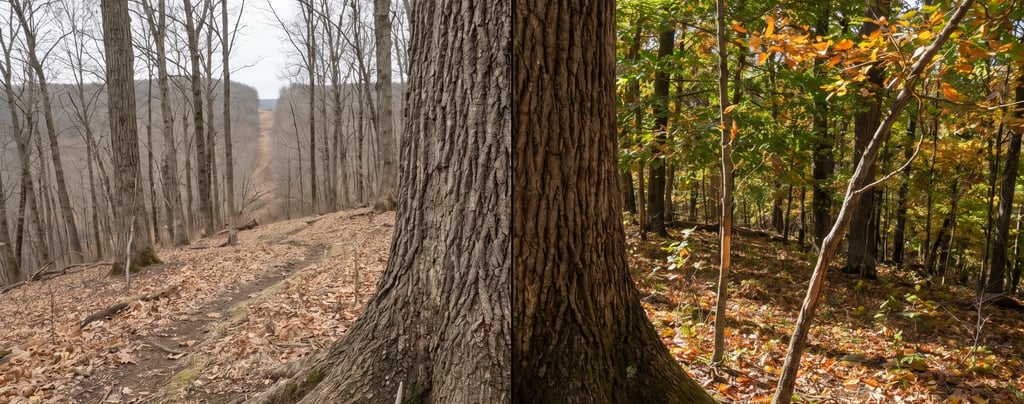
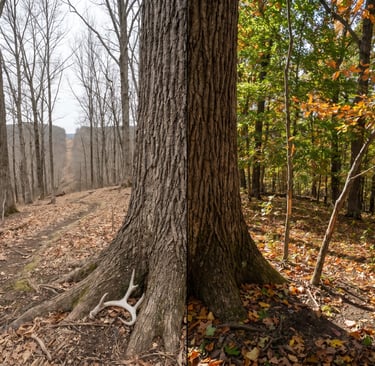
Advantage 1 — The Foliage Is Down and the Terrain Is Naked
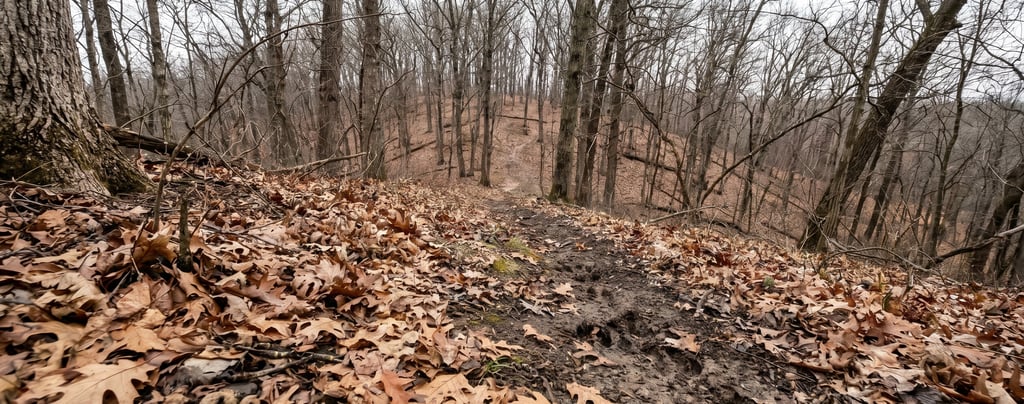
This is the single biggest structural advantage of spring scouting, and it is enormous. A mature hardwood forest in full October canopy is one of the most visually obstructed environments in nature. Funnels that channel deer movement disappear into the understory. Terrain saddles and ridge pinch points that would concentrate deer activity are buried under chest-high vegetation. Bedding cover that looks like impenetrable jungle in September is, in March, a perfectly readable mosaic of cover density, thermal exposure, and sight-line structure.
Walk your best hunting property in October and then walk it again in March. You will not recognize the same piece of ground. Features you spent years assuming did not exist will suddenly be visible from 200 yards. Funnels you never hunted because you never knew they were there will open up in front of you like a terrain briefing somebody forgot to hand you for the last decade. It is, every single time, mildly humbling — which, coincidentally, is also how both the Navy and the Marines tend to feel the first time they actually sit down and read each other's doctrine.
Terrain Features Spring Reveals That Fall Hides
• Ridge saddles and terrain pinch points: A saddle in a ridgeline — a low point between two higher elevations — is one of the most reliable deer crossing points in any landscape. Deer use saddles to cross ridges with minimum energy expenditure and maximum security. In fall foliage, saddles can be nearly invisible at stand-hanging distances. In March, they stand out like a gap in a fence line. Walk every ridge on your property right now and you will find saddles you have hunted beside for years without knowing they were there.
• Drainage funnels and creek pinch points: Where a drainage narrows, where a creek bends tight against a ridge, where two drainages converge — these are structural funnels that compress deer movement regardless of season, food source, or rut phase. They work because of geometry. The terrain makes it easier for a deer to go through than around. Spring makes these features readable from a distance. Fall buries them in vegetation that the deer can navigate from memory but you cannot read from a stand.
• Benches and shelves on hillsides: A bench — a flat or gently sloping shelf on an otherwise steep hillside — is prime bedding real estate. It provides elevation for scent and sight-line advantage, flat ground for comfortable bedding, and typically faces in a direction that gives thermal cover. In fall, benches are invisible from below and often from above. In March, you can read every bench on a hillside from 100 yards and assess its cover quality, thermal exposure, and approach angles before you ever set foot on it.
• Inside corners and field edge structure: Where a timber edge turns sharply inward, creating an inside corner between two field edges, you have a naturally sheltered staging area where deer linger before committing to an open field. These inside corners concentrate deer because they offer cover on multiple sides. They are obvious in March. They are hidden in October behind the very cover that makes them attractive to deer in the first place.
• Thick cover and bedding structure: Spring lets you inventory every thick cover block on your property for its bedding potential. You can assess stem density, ground-level visibility, thermal orientation, and escape route options without disturbing a single deer. In fall, entering bedding cover to assess it means blowing deer out of the area and potentially abandoning the stand site for weeks. In March, the cost of that reconnaissance is exactly zero.
Biologist's Note: Terrain does not change. Foliage does.
Every terrain feature that channels, concentrates, or shelters deer movement in October is doing the same thing in March — it is just visible. The funnel that moves deer past your stand in the rut is the same funnel you can see clearly from 150 yards in April. Find it now. Mark it precisely. When you return in September to hang a stand, you are executing a plan built on real terrain intelligence, not a guess made in the dark through a wall of leaves.
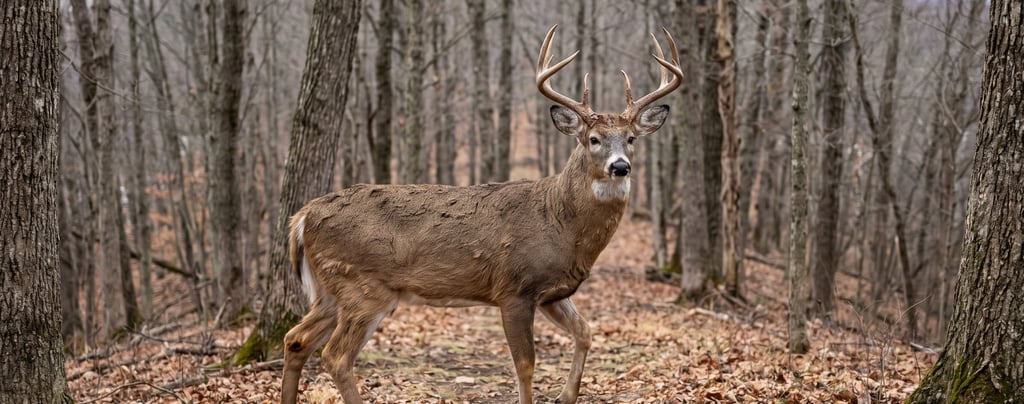
Advantage 2 — Old Sign Tells the Truth That Fresh Sign Cannot
This is a concept that trips up a lot of hunters, so let's be precise about it. Fresh sign — a hot scrape, a rub line made last week, a steaming pile of pellets — is exciting. It confirms current deer activity. But it does not tell you why the deer were there, whether that location reflects normal behavior or pressure-altered behavior, or whether that activity level is consistent with what happened in previous seasons.
Old sign — last fall's rubs still visible in March, scrape lines that have been worked so consistently the soil is permanently darkened, trails worn down to bare dirt by years of repeated use — tells you something fundamentally different. It tells you that this location matters to deer not just right now but persistently. Persistent use is what you want to hunt. Persistent use is what old sign reveals. And March is the best month of the year to read it, because the foliage is down and the sign is fully exposed.
Reading Last Season's Sign in Spring
• Rub lines: A rub on a tree is made when a buck works his antlers against bark, depositing scent from his forehead glands and visually marking his range. A rub line — multiple rubs in a directional sequence — maps a travel corridor. In March, last fall's rub lines are still visible if you know what you are looking for: scarred bark, dead wood chips at the base, exposed cambium that has dried and weathered. Follow the rub line. It will lead you to a travel route, a staging area, or a bedding entry point that was actively used just a few months ago.
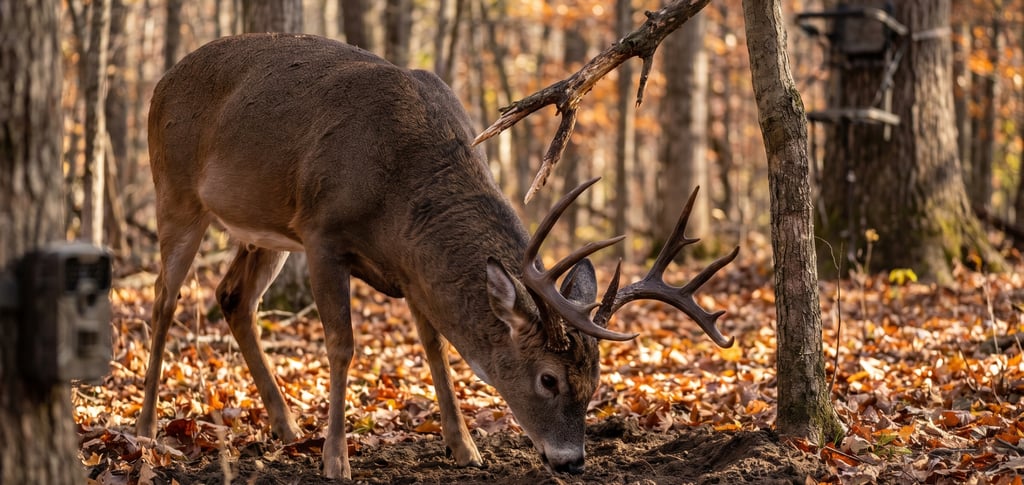
• Primary scrapes and licking branches: Primary scrapes — large, frequently worked scrapes associated with an overhanging licking branch — leave a signature that persists through winter and into spring. The soil remains disturbed. The licking branch is often visibly broken or heavily worked. These locations are not random. They are selected by deer because of their position in the landscape: typically near trail intersections, on terrain transitions, or at the edges of cover near food sources. Find a primary scrape in March and you have found a location that mature bucks returned to repeatedly during the rut. That is a stand site, not a coincidence.
• Trail systems and intersection points: A trail that has been used consistently enough to show bare dirt or a visible depression in the ground is a year-round travel corridor, not a seasonal accident. These trails are best read in spring when the low vegetation that grows over them by October is still dormant. Walk every trail intersection on your property and note where multiple trails converge. Trail intersections are funnel points on the micro-scale — exactly the locations where stand placement concentrates your odds.
• Bedding areas with oval depressions: Old bedding areas often show oval depressions in the leaf litter or ground vegetation where deer have repeatedly compressed the material by lying down. A cluster of large oval depressions — separated from smaller ones — indicates a bedding area used by bucks. These depressions are visible in spring and invisible by July when vegetation recovers. Find them now. Note their orientation relative to prevailing wind and thermal patterns. That is your stand approach information for the coming fall.
Field Tip: Photograph and GPS-mark every piece of significant old sign.
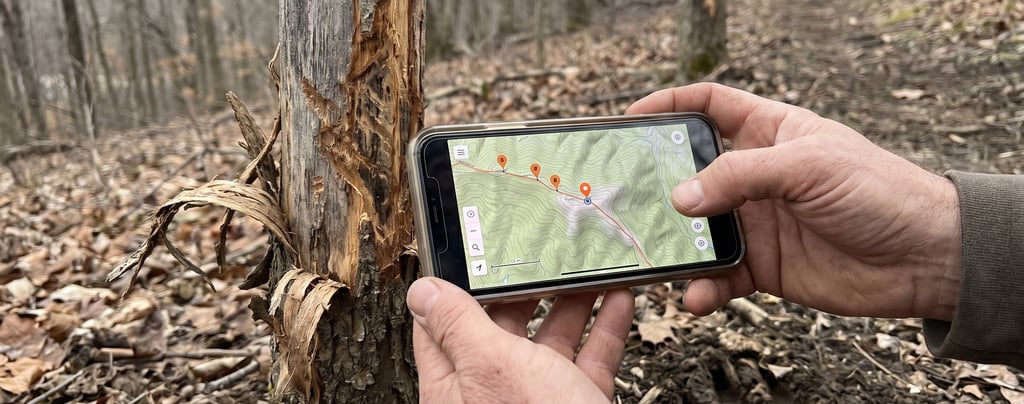
Do not rely on memory. Walk your property in March with your phone in your hand and drop a pin at every rub line, primary scrape, trail intersection, and bedding depression you find. Photograph the sign before you move on. By August, when you are planning your stand locations for September, that GPS pin map is the most valuable scouting document you own. It beats any aerial map, any trail camera archive, and absolutely any advice you will find on the internet — no offense to the internet, which has been wrong about deer hunting approximately as often as inter-service committees have been wrong about timelines.
Advantage 3 — Zero Pressure Means Zero Cost Intelligence
This is the advantage that hunters underestimate most consistently, and it is the one that has the most direct impact on hunting season outcomes. Every time you enter your hunting property between September and January, you are spending social capital with the deer that live there. You are adding a data point to their behavioral map that says: this area involves human activity, human scent, and human noise. Mature bucks process that data and adjust accordingly. They do not forget it. They do not forgive it. They simply shift their movement to avoid the risk.
Spring scouting costs you exactly nothing in that currency. The deer on your property in March are not making behavioral adjustments based on your presence. They are in post-rut recovery mode, nutritionally focused, and operating with the relaxed vigilance of an animal that has not been pursued in months. You can walk every inch of your property — push through bedding cover, stand at primary scrapes, sit on the ridgeline at sunset — and the only consequence is information. No pressure spent. No patterns disrupted. No mature buck logging your entry route into his threat database.
A Marine would call that a free reconnaissance. A Navy officer would call it an uncontested intelligence-gathering operation. Both would be right, and both would probably also have an opinion about who should lead it and whose maps to use — but that is a separate briefing we do not have time for today.
What Zero-Pressure Access Allows You to Do
• Walk your stand entry and exit routes in daylight and assess exactly what a deer would see, smell, and hear during your approach. Mark every obstacle, every branch that will snag your pack, every wet crossing that will add noise. Your fall approach route should be planned in spring, not improvised in the dark on opening morning.
• Sit in prospective stand sites and observe the terrain for an extended period without any cost. In fall, time spent in a stand location without the right wind or conditions is wasted hunting time and burned pressure. In spring, it is free research. Sit there for an hour. Watch where the terrain funnels movement. Observe the thermal patterns as the morning warms. Note where the sight lines open and where they close.
• Enter bedding areas to assess them directly without consequence. You cannot do this in fall without paying a severe pressure tax. In spring you can walk through every bedding thicket on your property, assess the cover quality and stem density, identify escape routes, and determine approach angles for future stand placement. Do this once in March and you will never have to guess about your bedding areas again.
• Test entry and exit routes for scent contamination risk. Walk your planned fall approach route and honestly assess how many thermals you cross, how close you pass to bedding cover, and whether there are alternate routes with lower risk profiles. Spring is the time to find the better route, not October when every wrong turn costs you a week of hunting.
• Assess stand site visibility from the deer's perspective. Stand at the locations where deer will be when you are in your stand and look toward your stand site. What does a deer see? What movement will be visible? What silhouette will you create? This kind of perspective work is only possible without pressure consequences in spring.
Biologist's Note: Pressure is cumulative and persistent.
A mature whitetail buck does not reset his threat assessment of your property on September 1st. The pressure you applied in October, November, and December of last season is still factored into his behavioral patterns this fall. Every location you burned with unnecessary intrusion last year starts this season at a deficit. Spring scouting allows you to gather intelligence that prevents future pressure mistakes — which is far more valuable than finding out where the deer are in October by accidentally bumping them out of a location you should have scouted six months earlier.
What Fall Scouting Is Actually Good For
Before the fall scouting advocates in the audience load their arguments and prepare to return fire — and I know you are out there, because whitetail hunters are nothing if not committed to their preferences regardless of what the biology says — let me be clear: fall scouting has legitimate value. It is not useless. It is contextually limited, pressure-expensive, and misapplied far more often than it is used correctly. But when used correctly, it fills gaps that spring scouting cannot.
The Legitimate Uses of In-Season Scouting
• Reading fresh rut sign in real time: There is genuine intelligence value in finding a hot scrape line during the first week of November and adjusting your stand placement to intercept the buck working it. That is time-sensitive information that does not exist in spring. The key is executing the adjustment with minimum disturbance — quick in, stand hung, out the same way, no lingering.
• Identifying active food sources: Food source use shifts throughout the season as mast crops are depleted, brassicas sweeten after frost, and agricultural fields are harvested. Monitoring these shifts requires in-season observation. Trail cameras handle most of this, but a careful ground check of sign concentration near food sources can confirm what the cameras suggest.
• Tracking pressure-driven range shifts: If a buck you have been targeting shifts his core area in response to hunting pressure — neighbor pressure, your own pressure, or firearms season pressure — you may need to do in-season reconnaissance to find where he went. This is a reactive scouting scenario, not a proactive one, and it carries a pressure cost. But sometimes it is the right call.
• Post-season shed and sign inventory: The best fall scouting arguably happens after season closes — January through March. Zero hunting pressure. Fresh winter sign. New shed finds. And you are not burning any of next season's pressure budget. This is the gray zone between fall scouting and spring scouting, and it is arguably the most productive scouting window of all for hunters willing to be in the woods in January.
The pattern you should notice is that legitimate fall scouting is either reactive to real-time information that spring cannot provide, or it happens after season when pressure costs are zero. The version of fall scouting that costs the most and returns the least is the September walkthrough — entering your best hunting areas during the most pressure-sensitive time of year to confirm what you already should have learned in March.
Honest Assessment: Most September scouting is expensive confirmation of what spring scouting would have told you for free.
If you are walking your property in September to figure out where to hang stands, you are paying full pressure price for information that was freely available six months ago. The bucks you bump in September will remember your entry route in October. The bedding area you push through to check for sign will be abandoned or used only nocturnally for weeks. Every September walkthrough that yields a stand location you could have identified in March is a pressure investment with a negative return. Stop making it. Do the spring work. Show up in September with a plan, not a question.
Your Spring Scouting Framework — What to Do and When
Knowing that spring scouting is superior is not enough. You need a systematic approach that extracts maximum intelligence from the window before the foliage returns and closes it. Here is the framework built from thirty years of applying wildlife biology to Southern deer woods:
Phase 1 — February through Early March: Post-Season Sign Inventory
This phase happens while the season is still fresh in the deer's behavioral pattern and the sign from last fall is most readable. Focus on:
• Pulling and reviewing all trail cameras from last season. Build your survivor buck list before you start any ground work.
• Walking all food plot and feeding area edges for concentrated sign — tracks, rubs, scrapes — that confirms which areas were actively used through late season.
• Mapping all rub lines you can find. Photograph and GPS-mark every significant rub. The direction of the rub sequence tells you the direction of travel.
• Locating primary scrapes and confirming their terrain position. Why is this scrape here? What trail intersection or terrain feature makes this a logical location for a licking branch?
Phase 2 — Mid-March through April: Terrain and Bedding Reconnaissance
This is the core spring scouting window. Foliage is fully down, snow has receded in northern regions, and the terrain is maximally readable. Focus on:
• Walking every ridgeline on your property to identify saddles, pinch points, and terrain transitions. Mark every one precisely.
• Following every drainage to identify funnels, creek pinch points, and convergence zones where multiple drainages meet.
• Entering every thick cover block to assess bedding quality, escape routes, thermal exposure, and stand approach options. Take notes. Take photos. This is your bedding area intelligence file.
• Identifying and evaluating stand site candidates for the coming season. For each candidate, note the wind requirements, entry route, exit route, and the terrain features that make it a stand location rather than just a tree with a hook in it.
• Walking every planned stand entry and exit route in daylight. Note obstacles, scent risks, and terrain that makes noise. Find the quiet route now, not in October.
Phase 3 — Late April through May: Shed Match and Camera Repositioning
By late April the foliage is returning and your window for terrain reading is closing. Shift your focus to:
• Completing your shed inventory and matching sheds to camera history. Confirm your survivor buck list and build your target file for next season.
• Repositioning trail cameras based on what the spring scouting revealed. Move cameras to the saddles, funnels, and terrain features you identified. Cover the blind spots your scouting map revealed.
• Finalizing your stand location plan for the coming season. Every stand site you plan to hunt in September should be identified, evaluated, and approach-routed before June.
The Spring Scouting Mindset: You are building a map, not chasing deer.
Spring scouting done correctly feels less like hunting and more like fieldwork — because it is fieldwork. You are conducting a biological survey of your property: mapping terrain features, inventorying sign, assessing habitat quality, and building the intelligence file that will drive your fall hunting decisions. It is methodical, unglamorous, and quietly decisive. The hunters who do it consistently are the ones who show up in September with a specific plan for a specific stand on a specific wind condition targeting a specific deer. Everyone else shows up with a general intention and high hopes. The woods reward the former and politely ignore the latter — regardless of what branch of service you served in, what maps you used, or how loudly anyone argued about the plan on the way to the trailhead.
Final Thoughts — March and April Are Not the Off-Season
The hunting industry has done a thorough job of convincing whitetail hunters that the season runs from September through January and the rest of the year is downtime. It is a profitable narrative for the people selling gear, but it is biologically backwards. The decisions that determine your success in October are made in March. The intelligence that positions your stand in the right place is gathered in April. The work that separates a strategic hunter from a hopeful one happens right now, while most people are watching turkey hunting videos and waiting for summer.
March and April give you a fully exposed property, zero pressure costs, readable terrain, honest old sign, and a window to build the most complete intelligence picture you will have access to all year. That window closes the moment the canopy returns, and it does not reopen until next February. Use it deliberately. Use it systematically. Use it with the same discipline you would apply to any intelligence-gathering operation where the quality of the information you collect determines the quality of the outcome you achieve.
Because here is the truth that thirty years in the deer woods has confirmed for me: the hunters who kill mature bucks consistently are not luckier than everyone else. They are better informed. They scouted in spring when the information was free and the terrain was readable. They built a plan on biology and evidence instead of tradition and hope. And they showed up in September knowing exactly where they were going, exactly why they were going there, and exactly what wind they needed to make it work.
That is what spring scouting gives you. That is why March and April are your most valuable months.
Science. Patience. Discipline. Hooyah. Carry on.
Contact
Questions? Tactical tips? Reach out anytime.
hello@biologistonbucks.com
© 2025. All rights reserved.
Attention on Deck — Image Disclaimer
The deer images on this site are a mix of AI-generated imagery and real photos taken by me personally in the field and deer woods of the Southern United States. I'm a wildlife biologist and a hunter, not a photographer. Much like the Navy taught me, you use the best available asset for the mission. A camera and a whitetail buck operate on completely different schedules, and unlike the Marines, I'm smart enough not to fight a battle I can't win.
When you see a photo tagged "Field Image" — that one's the real deal, straight from the woods. The rest are AI-generated and proud of it. Either way, the science is real, the strategies are real, and the deer in every photo represent exactly what we're all out there chasing every fall.
Hooyah. Carry on.