
Why Every Shed Antler is a Data Point. A Biologists Guide to Spring Shed Hunting
Shed hunting season is one of the most underutilized scouting opportunities in the whitetail calendar — and most hunters are leaving critical intelligence on the forest floor. In this long-form educational article, a wildlife biologist and Navy veteran breaks down the complete biology of antler casting, from the photoperiod-driven testosterone crash that triggers the cast to what shed locations reveal about winter range use, thermal cover selection, and individual buck behavior. Learn how to GPS-log every find, match sheds to trail camera inventory, build a multi-season scouting database, and integrate shed data directly into your pre-season stand placement strategy. Whether you're grid searching a new property or running targeted searches on ground you've hunted for years, this guide gives you the biological framework to turn every shed antler into actionable hunting intelligence. Science. Patience. Discipline. Hooyah.
Allen
3/31/202611 min read
Most deer hunters treat shed hunting as a fun off-season activity — a way to stretch their legs, scratch the itch of being in the woods, and maybe score a cool set of antlers for the mantelpiece. That's fine. But if you're approaching April woodswalks with nothing but a basket and good intentions, you're leaving some of the most valuable scouting intelligence of the entire year on the forest floor.
Every shed antler you find is a data point. It tells you a specific deer was alive and healthy on a specific piece of ground during a specific time window. Stacked together, your shed finds build a biological portrait of your property that no trail camera, aerial map, or food plot survey can fully replicate. It's the kind of systematic, evidence-based intelligence gathering that wins long campaigns — not the kind where you kick in a door and hope for the best.
In this article, we'll cover the biology of why and when deer cast their antlers, what shed locations reveal about winter range and social behavior, and how to systematically fold that information into your year-round scouting file. Let's get into it.
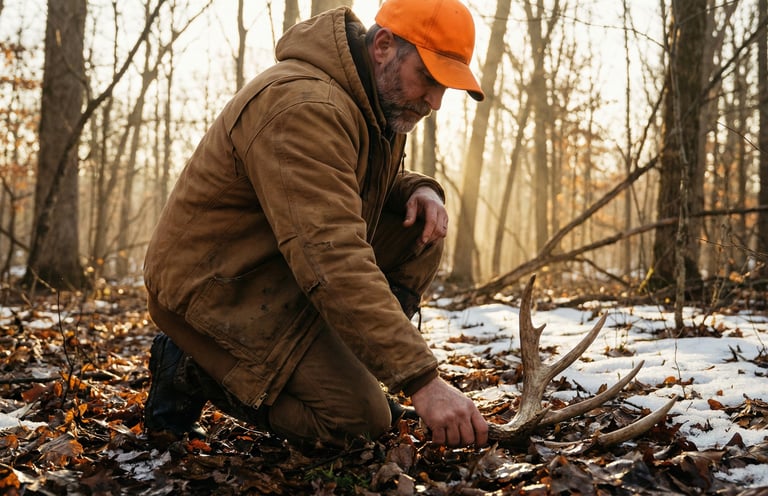
The Biology of Antler Casting
Why Deer Drop Their Antlers — The Hormonal Trigger
Antler casting isn't random. It's a precisely orchestrated hormonal event driven primarily by photoperiod — the changing ratio of daylight to darkness as winter progresses toward spring. As day length begins increasing after the winter solstice, specialized photoreceptors in the deer's eye register the shift and signal the pineal gland to reduce melatonin output. This cascade eventually prompts the pituitary gland to reduce luteinizing hormone (LH), which in turn causes a sharp decline in testosterone.
It is that testosterone crash — not cold temperatures, not nutritional stress, not calendar date — that triggers osteoclast activity at the pedicle-antler junction. Osteoclasts are bone-resorbing cells that break down the connection between the hardened antler and the live pedicle tissue beneath it. Once the junction weakens sufficiently, even light pressure — a head shake, a jump across a ditch, a sniff at a scrape — can knock a beam free.
In short, the entire process is run by a finely tuned biological command-and-control system operating on precise hormonal signals. Not brute force, not guesswork, not whoever yells loudest. Pure, elegant science — which puts it about three steps ahead of most joint operations briefings I've ever sat through.
Biologist's Note: Testosterone is the master switch.
Nutritional stress, injury, and genetics can shift the timing window, but photoperiod-driven testosterone decline is the primary driver of casting in healthy whitetail populations. A buck with severely compromised nutrition may cast early, but a well-fed buck still casts on schedule. The deer's endocrine system runs a tighter operation than most inter-service planning committees — and with considerably less paperwork.
The Casting Timeline — When Do Bucks Drop?
Across the whitetail's core range, most bucks cast between late December and early March, with the peak typically falling in January and February. However, this window is not uniform across age classes or geography.
Mature bucks — those 4.5 years and older — tend to cast earlier than younger deer. This is somewhat counterintuitive, since older bucks typically carry larger antlers and maintain higher testosterone levels through the rut. The explanation lies in energetic cost: the metabolic burden of carrying heavy bone through winter prompts an earlier hormonal reset, allowing the body to redirect resources toward spring recovery and the next growth cycle. Mature bucks are efficient. They shed unnecessary weight the moment it stops serving a purpose. It's a level of logistical discipline that would impress anyone who has ever watched a Navy supply chain operate — or tried to, anyway.
Yearling and 2.5-year-old bucks often hold their antlers into late February or even early March. In the South, where milder winters reduce metabolic stress, casting can extend even later — occasionally into April for young deer in excellent condition.
What this means practically: small, spindly antlers found in March likely belonged to a young buck. A heavy, well-palmated shed found in late January almost certainly came from a mature deer. Timing and size both matter. The data doesn't care about your rank.
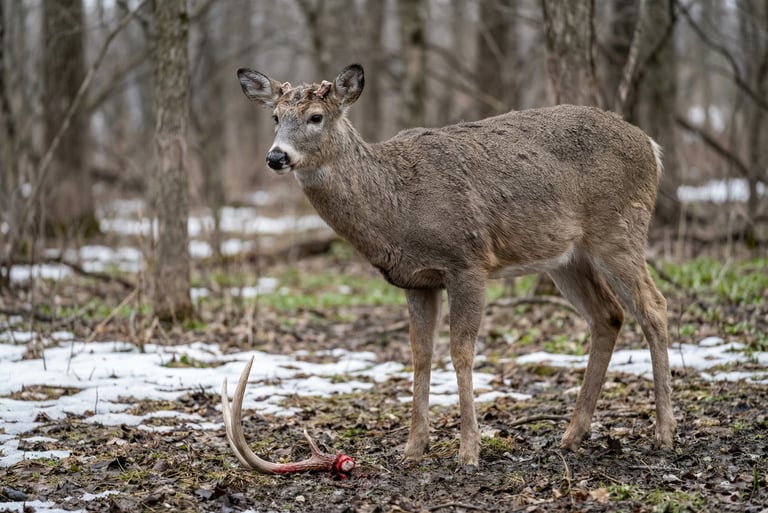
What Shed Locations Tell You About Winter Range
Winter Refuge vs. Summer Range — Bucks Aren't Always Where You Think
One of the most important concepts in whitetail management is the distinction between summer range, fall range, and winter range. These are not the same areas. A buck you're patterning on your property in October may not spend a single night there in January — and vice versa.
Shed antlers are among the most reliable indicators of winter range use. Where a buck drops his antlers is where he was spending the majority of his time during late season and post-rut recovery — survival habitat, not hunting-season habitat. Think of your October stand locations as the high-visibility operational theater, and your shed find locations as the quiet forward operating base where the real recovery work gets done. Both matter. Neither tells the full story without the other. Kind of like how the Navy and Marines technically need each other, even if nobody wants to admit it at the bar.
If you're finding sheds in locations that surprise you — dense bedding thickets you rarely hunt, south-facing slopes you've overlooked, overgrown field edges half a mile from your best stand — pay attention. Those locations may represent the actual gravitational center of that buck's annual home range.
Reading the Landscape Through Shed Locations
Here's a terrain intelligence framework for interpreting shed finds by habitat type. Study it carefully. The deer have been running this playbook for thousands of years and nobody gave them a briefing packet:
South-facing slopes and ridges: Deer bed here to absorb solar radiation during cold snaps. Sheds found on south aspects in late January and February indicate thermal cover use — the buck was conserving energy, not moving aggressively. These are high-value bedding sites worth protecting from human intrusion year-round. Treat them like restricted areas. No unauthorized personnel. That means you, too, even if you outrank the deer.
Dense conifer pockets and swamp edges: In northern climates, dense conifers — hemlock, spruce, cedar swamps — provide critical thermal buffering. Sheds here indicate deep winter refugia. Bucks in these areas may be nearly nocturnal and minimally mobile. They are laying low, conserving resources, and waiting out conditions. It's a solid strategy — one the Navy occasionally employs when paperwork gets complicated.
Agricultural edge habitat and food plots: Late-season sheds near corn stubble, brassica plots, or standing beans indicate a buck actively feeding through winter. He's healthy, he's on a schedule, and he's coming back to the same sources reliably. Pattern him accordingly. Predictable behavior is exploitable behavior — a truth that applies equally to whitetails and to anyone who eats at the same chow hall table every single day.
Fence crossings, ditch jumps, creek crossings: Mechanical stress at these features often dislodges a loosened antler. A shed at a fence crossing tells you about a travel corridor, not a core use area. Look for the matching side within 50-100 yards in the direction of travel. Follow the evidence. Don't just stand at the fence crossing and declare the mission accomplished — a mistake made by committees of all branches, in my experience.
Property boundaries and adjacent land: Consistent sheds near property lines suggest the buck's core winter range extends onto neighboring ground. This should inform your harvest strategy and prompt a conversation with your neighbors. Communicate early, communicate clearly, and don't wait until opening day to figure out whose deer it actually is. Inter-unit coordination. Groundbreaking concept.
Pairing Shed Finds with Trail Camera Inventory
Closing the Loop on Survival Confirmation
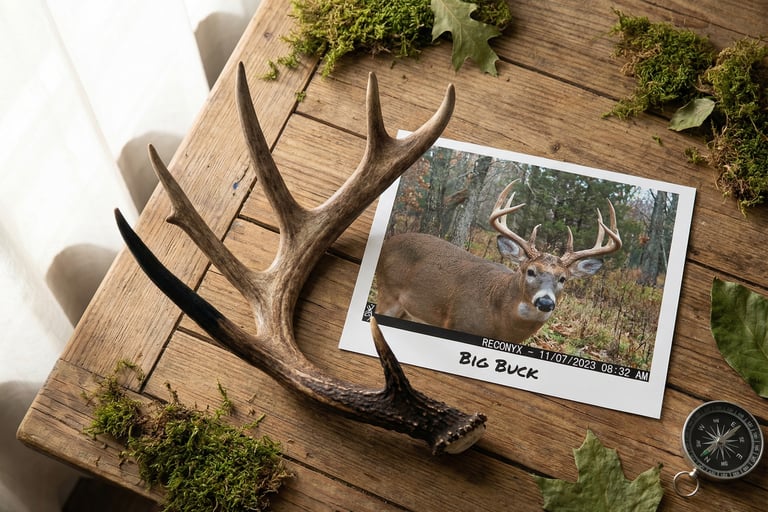
Trail cameras tell you who was present during a specific time window. They don't tell you whether a buck survived hunting season and the winter that followed. Shed antlers close that loop definitively.
When you match a shed to a buck you have on camera — by beam curvature, tine configuration, sticker points, or distinctive asymmetry — you've confirmed two things: that buck survived to cast, and he was on your property during the casting window. That's verified survivorship data. The difference between a rumor and a confirmed contact. Any good intelligence shop — Navy, Marine, or otherwise — will tell you that confirmed contacts are worth ten unverified rumors. Though in my experience, the ratio of rumors to confirmed contacts at most deer camps runs closer to fifty to one.
Make this matching process systematic. Photograph every shed in the field from multiple angles before moving it. Log the GPS coordinate. When you get home, pull your trail camera archives and look for a match. Even approximate matches are worth recording with a confidence rating.
Pro Tip: Build a Shed Inventory Database
Even a basic spreadsheet — Date Found, GPS Coordinate, Antler Side, Beam Length, Tine Count, Notable Features, Matched Buck ID — transforms your shed collection from a wall display into a longitudinal data set. After three to five seasons you'll have a property-level picture of winter survival rates, range fidelity, and age-class progression that most hunters never develop. Maintain it. Update it every season. A neglected intelligence file is just a pile of paper — or in this case, a pile of antlers gathering dust in the garage while you wonder why you keep missing that one buck.
Identifying Individual Bucks Across Multiple Seasons
Antler geometry is remarkably consistent across years for individual bucks — beam curvature, tine spacing, and the presence of non-typical points or sticker tines. A buck that carries a split brow tine at 3.5 years will carry a larger version of the same feature at 4.5. Genetics are consistent. They don't change based on who's watching or what the situation calls for, which puts them ahead of most institutional behavior I've observed across multiple branches of service.
This means shed antlers can be matched longitudinally — connecting a small shed from two springs ago to a larger shed from last spring to a trail camera photo from October. When that chain of evidence comes together, you've tracked an individual deer across multiple years without ever physically handling him. Persistent surveillance. It works on deer. It works in the field. It works everywhere except when the GPS dies and everyone on both sides of the aisle suddenly can't read a paper map.
This individual-level data is the foundation of quality deer management. It allows you to make defensible harvest decisions grounded in real biological history — not campfire guesswork, not social media pressure, and not whatever the guy in the next stand says he saw last Tuesday.
Building Your Scouting File — A Systematic Approach
GPS Logging Every Find
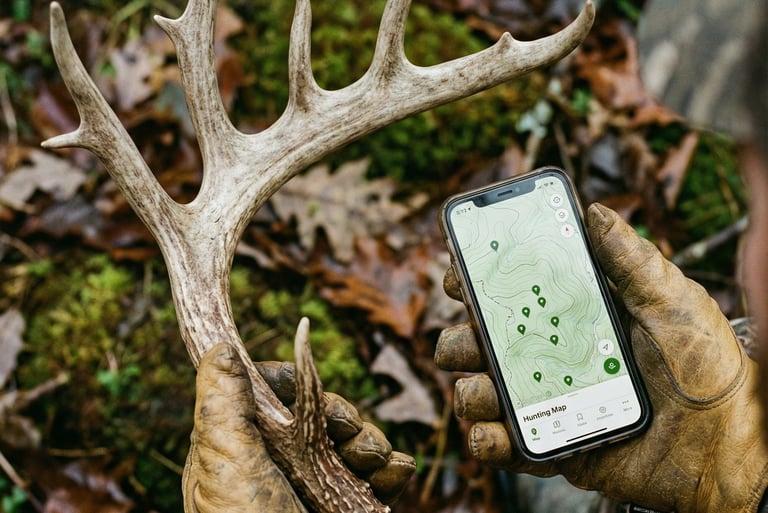
The single most important upgrade you can make to your shed hunting practice is GPS-logging every find. Not the general area — the precise coordinate. OnX Hunt, BaseMap, and HuntStand all allow you to drop pins with custom icons and notes. Use them every time, without exception.
You wouldn't mark a navigational hazard as 'somewhere near the coast,' and you wouldn't mark a confirmed enemy position as 'over that way a bit.' Precision is a habit, and habits built in April pay dividends in October. Over time, your shed pin map reveals spatial patterns invisible to casual observation — drainage preferences, ridge alignments, proximity to water and cover edges. These patterns should directly inform stand placement, habitat management decisions, and pressure management strategy.
Recording Environmental Context
When you log a shed find, record more than just the location. Note the habitat type, the date, snow conditions if applicable, and the nearest camera location. If you find a matched pair, note the distance between them and the apparent direction of travel.
A find logged as 'Buck, south-facing slope, dense cedar, 6 inches snow, January 18' tells you something biologically meaningful. A find logged as 'antler, back 40' tells you almost nothing. Contextual data is what separates a pin map from a genuine intelligence file. We hold ourselves to higher standards than 'antler, back 40.' At least, we try to. Some days the woods win and you're just happy you found both sides.
Integrating Shed Data into Pre-Season Planning
By September, your shed data should be actively shaping stand placement and entry/exit route decisions. Here's the operational checklist — concise, actionable, no unnecessary jargon, which puts it ahead of roughly 40 percent of the planning documents I've encountered in uniform:
Bucks that shed consistently in the same area over multiple years have strong range fidelity. Prioritize stand locations that intercept movement between their winter core and fall feeding and breeding areas.
High shed density with no trail camera history suggests nocturnal movement. Shift cameras to capture nighttime activity in those zones before season.
South-facing slopes with consistent shed finds are premium late-season stand locations. Hunt them during cold fronts in December — quietly, patiently, and with an actual entry and exit plan. Revolutionary, I know.
Boundary-adjacent sheds require neighbor outreach and a strategic harvest review. Figure out whose deer it is before someone makes a unilateral decision. Inter-unit coordination saves friendships. And sometimes deer.
The Shed Hunter's Code — Timing and Low-Pressure Access
Don't Walk Your Property Too Early
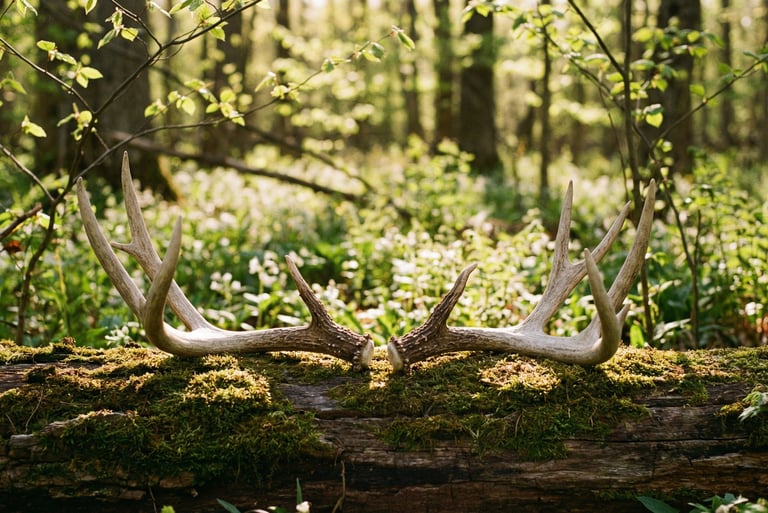
One of the most common and damaging shed hunting mistakes is hitting the woods too aggressively in January and February before bucks have fully cast. Pressuring deer during critical late-winter recovery — when they are energetically depleted from the rut and facing the coldest, most nutritionally stressful weeks of the year — can have real consequences for individual deer health and overall herd condition.
Patience separates the hunters from the hikers. Wait until late February through mid-March before conducting a systematic search. Use trail cameras on winter food sources to monitor antler status first. When you start seeing bucks on camera without headgear, the window is open. Execute the mission when conditions are right, not just because cabin fever has reached critical levels and you need to do something with your boots. Trust me, I've been there. The deer don't care about your timeline — a truth that applies whether you're wearing a Navy anchor or a Marine globe on your hat or t-shirt.
Grid Searching vs. Targeted Searching
There are two general approaches to shed hunting: systematic grid searches and targeted searches of high-probability zones. Both have value. The right choice depends on your property size and the biological knowledge you've already accumulated.
If you're building your database from scratch, grid searching establishes baseline coverage — methodical, systematic, no stone unturned. It is painstaking work that requires genuine discipline to execute well. The Marines would say it sounds a lot like land navigation. The Navy would say it sounds a lot like a sonar sweep. They'd both be right, and they'd both complain about it the entire time, which is one of the few things the two branches have genuinely in common.
If you have several seasons of prior data, targeted searching is more efficient. Focus initial effort on south-facing bedding areas, late-season food sources, and known travel corridors. Expand outward from confirmed finds in arcs — matching pairs are usually within 100 yards of each other, and secondary bucks tend to use the same terrain features as the mature deer you're targeting.
Final Thoughts — Every Antler Tells a Story
Shed hunting done intentionally is one of the most productive low-pressure scouting activities in the whitetail hunter's calendar. April walks aren't just about the find — they're about building a biological model of the deer living on your property, one verified data point at a time. It doesn't look glamorous on social media, but it quietly determines who kills mature bucks and who spends October wondering where they went.
The buck that dropped that dark, heavy main beam on the south-facing cedar ridge in February survived the season. He spent his winter recovery in a specific place for specific biological reasons, running a program written in his own genetics and hormones. He'll be back this fall, using the same general range, responding to the same terrain features and food sources. The question is whether you'll be positioned to intercept him — or whether you'll still be arguing about whose fault it is that nobody marked the location.
Start your shed database this spring. Log your finds with precision. Match sheds to camera history. Map the patterns. Brief yourself before season. The work you do in April with a GPS and a field notebook is the work that puts a mature buck in front of you in October.
Science. Patience. Discipline. Works every time — for biologists, for deer, and for anyone from any branch willing to put in the unglamorous work that nobody posts about online.
Hooyah. Carry on.
Contact
Questions? Tactical tips? Reach out anytime.
hello@biologistonbucks.com
© 2025. All rights reserved.
Attention on Deck — Image Disclaimer
The deer images on this site are a mix of AI-generated imagery and real photos taken by me personally in the field and deer woods of the Southern United States. I'm a wildlife biologist and a hunter, not a photographer. Much like the Navy taught me, you use the best available asset for the mission. A camera and a whitetail buck operate on completely different schedules, and unlike the Marines, I'm smart enough not to fight a battle I can't win.
When you see a photo tagged "Field Image" — that one's the real deal, straight from the woods. The rest are AI-generated and proud of it. Either way, the science is real, the strategies are real, and the deer in every photo represent exactly what we're all out there chasing every fall.
Hooyah. Carry on.